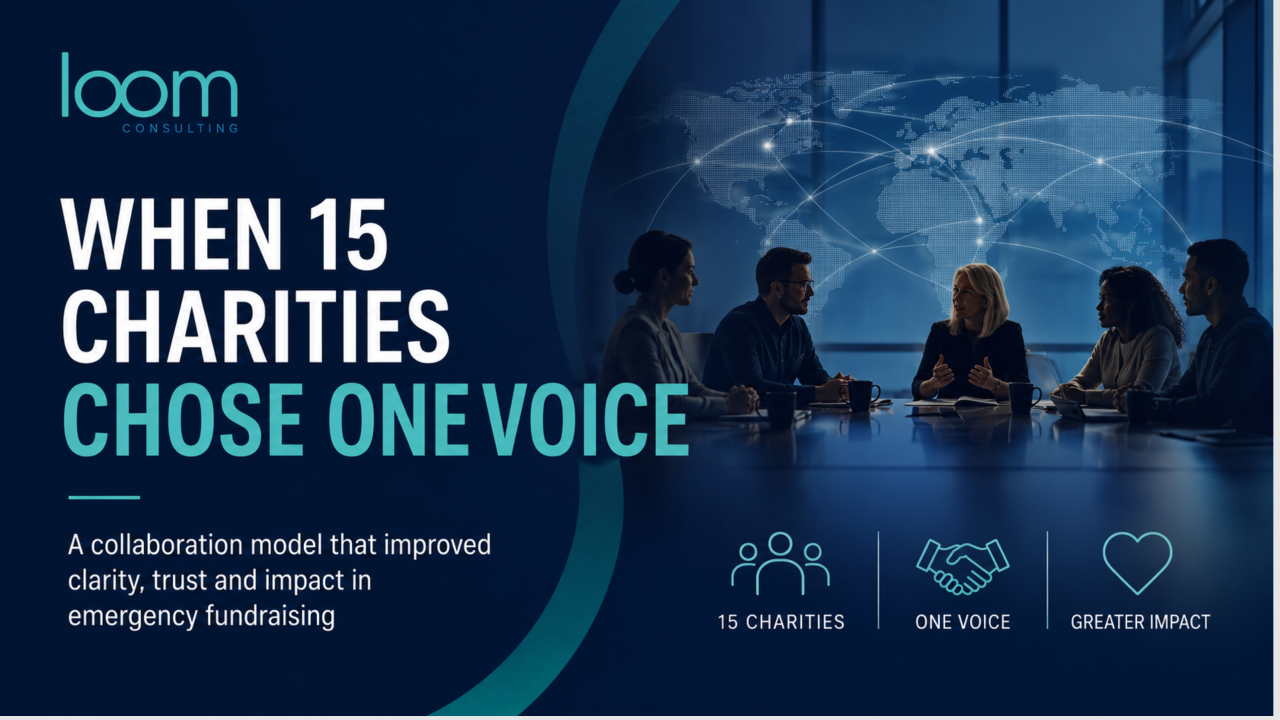
What the Emergency Action Alliance shows about collaboration, trust and impact.
Key Takeaways
- The Emergency Action Alliance offers a useful example of collaboration designed around public trust, clarity and impact.
- When many organisations ask for support during the same crisis, the public can experience good intent as confusion.
- A shared campaign can make it easier for donors, government and media to understand how to respond.
- The most useful collaboration question is not always about merger. It is often about what structure gives the work the best chance of reaching people well.
- Boards should look closely at where separate organisational effort may be making the mission harder to understand, access or support.
There are moments when too many good organisations doing good work can still create a difficult experience for the people they are trying to reach.
Humanitarian fundraising is one example.
When a major international emergency occurs, public concern can rise quickly. People want to help. Media attention is high. Governments, donors and communities are looking for a credible way to respond.
For years, the familiar pattern was that many aid organisations would each take their own campaign to market. Each appeal had a legitimate purpose. Each organisation had experience, capability and a supporter base. Each one was trying to raise money quickly for people in urgent need.
From inside the organisations, that made sense.
From the outside, it could feel confusing.
A donor may see several trusted charities asking for support for the same emergency. The cause is clear, but the pathway is not. Which organisation should receive the donation? Which one is best placed to respond? Which campaign will get funds to the right place? Which message should be trusted?
The issue is not a lack of generosity. It is a lack of clarity.
That is what makes the Emergency Action Alliance such a useful case study for boards and executive teams thinking about collaboration, merger and shared structures.
The Problem Was Fragmentation
In a recent conversation with Rachel Nicholls, she spoke about the Emergency Action Alliance as one of the examples featured in her work on more meaningful mergers.
It is not a traditional merger in the clean legal sense. It is the creation of a new collective entity, supported by 15 humanitarian organisations, designed to respond when major international emergencies occur.
That distinction matters, because it shows why the language of merger can sometimes get in the way of the more important question.
"The real issue is not whether the model fits neatly inside one category. The real issue is whether it helps the work achieve more impact."
In this case, the problem being solved was clear. When each organisation went to market separately, the public message became fragmented. Media attention was divided. Donors were being asked to choose between multiple organisations responding to the same crisis.
The Emergency Action Alliance created a different pathway:
One coordinated appeal.
One clearer public message.
One place for people to give when they wanted to help but did not know which organisation to choose.
That is collaboration doing something practical. It is not collaboration as a value statement. It is collaboration as a design response to a real problem.
Clarity Builds Trust
The public rarely sees the internal logic of the sector.
People outside an organisation do not always know which charity has the strongest logistics capability, which one has the deepest local partnerships, which one is best placed for immediate relief, or which one is more effective in longer-term recovery.
They see the need.
They see the ask.
They decide whether they trust the pathway enough to act.
That is why clarity matters so much in fundraising. A confusing landscape can slow generosity, even when the public wants to respond. Too many messages can make the decision harder. Too many separate asks can unintentionally weaken confidence.
A collective campaign helps reduce that burden.
The Emergency Action Alliance does not remove the value of the member organisations. It draws on it. The credibility, expertise and capability of the participating agencies sit behind the shared public appeal.
Existing supporters may still give directly to the organisations they already know and trust. But the collective model creates a clearer option for people who are moved by the emergency and simply want to know where to give.
That is a useful lesson beyond humanitarian aid.
Many parts of the for-purpose sector are difficult for communities, funders and donors to navigate. There may be several organisations working in similar areas, using different language, presenting different entry points, and asking for support in different ways.
The work may be valuable. The people may be committed. The need may be real.
"If the pathway is confusing, the model may be making the mission harder to support."
The Form Should Follow the Purpose
Boards can sometimes move too quickly to the structural question.
Is this a merger? Is it a joint venture? Is it an alliance? Who owns it? What happens to the brand? What happens to the board? What has to be protected?
Those questions are important, but they are not the best place to begin.
The better starting point is the problem being solved.
For the Emergency Action Alliance, the problem was not that the 15 organisations needed to disappear into one. The problem was that separate fundraising campaigns during the same emergency were not creating the clearest experience for donors, government or media.
The structure followed that purpose.
That is a more mature way to think about collaboration. It allows leaders to explore the form that best fits the work, rather than treating merger as the only serious option or independence as the only safe one.
In some cases, the right answer may be a shared service. In others, it may be a joint campaign, a common intake point, a collective advocacy platform, a formal partnership, a group structure or a full merger.
The form matters. But it should come after a disciplined conversation about purpose, impact and the experience of the people outside the organisation.
What Boards Can Learn from This
The Emergency Action Alliance raises a simple but uncomfortable question for boards:
"Where is our separate effort making things harder than they need to be?"
That question can apply to fundraising, advocacy, service access, client pathways, shared infrastructure, technology, workforce, data or government engagement.
It does not assume that every organisation should merge. It does ask leaders to look honestly at whether the current model is still the best way to carry the mission.
For some organisations, independence will remain the right answer. For others, the better answer may be a deeper form of collaboration that reduces duplication, improves trust and gives the community a clearer way to engage.
The point is to ask the question early enough to still have choices.
When collaboration is only explored during crisis, the conversation often becomes narrower. Time is shorter. Emotions are higher. Options are fewer. Partners are harder to find. What might have been a strategic conversation can begin to feel like a rescue exercise.
Stronger boards make space for these questions before the pressure becomes unavoidable.
The Real Measure Is What Becomes Easier
A useful collaboration should make something important easier:
- Easier for clients to find help.
- Easier for donors to give with confidence.
- Easier for funders to understand the case.
- Easier for government to engage.
- Easier for teams to focus on the work rather than duplicate the structure around it.
That is the deeper lesson from the Emergency Action Alliance.
Fifteen organisations did not need to disappear for the public message to become clearer. They needed a shared vehicle strong enough to hold the appeal, direct funds to those responding, and give Australians a more trusted pathway in a crisis.
That is not a technical distinction about merger definitions. It is a leadership lesson.
Collaboration is strongest when it makes the mission easier to understand, easier to support and more likely to reach the people who need it.
The question for boards is where that opportunity may already exist in their own sector, service system or community.