A new board discussion guide helps for-purpose organisations move from general support for collaboration to a practical conversation about purpose, sustainability and future impact.
Key Takeaways
- Collaboration needs a place in board discussion, alongside a clear process for exploring its value.
- Starting with purpose and future capability gives directors a stronger foundation than starting with potential partners.
- Boards can explore collaboration without committing to a particular outcome.
- Loom's new Board Discussion Guide to Strategic Collaboration offers five questions to help boards begin.
Collaboration appears in plenty of strategic plans. Turning that intention into a useful board conversation can be harder.
What does collaboration mean for this organisation? What would it help achieve? Who should begin the conversation, and where should they start?
In my work with for-purpose organisations, I see two recurring situations. Some boards give collaboration little attention at all. Others recognise its potential and include it in their strategy, but struggle to move from saying the word to real action.
So a powerful strategic question goes unexplored: does our current operating model give us the best opportunity to fulfil our purpose over the next decade?
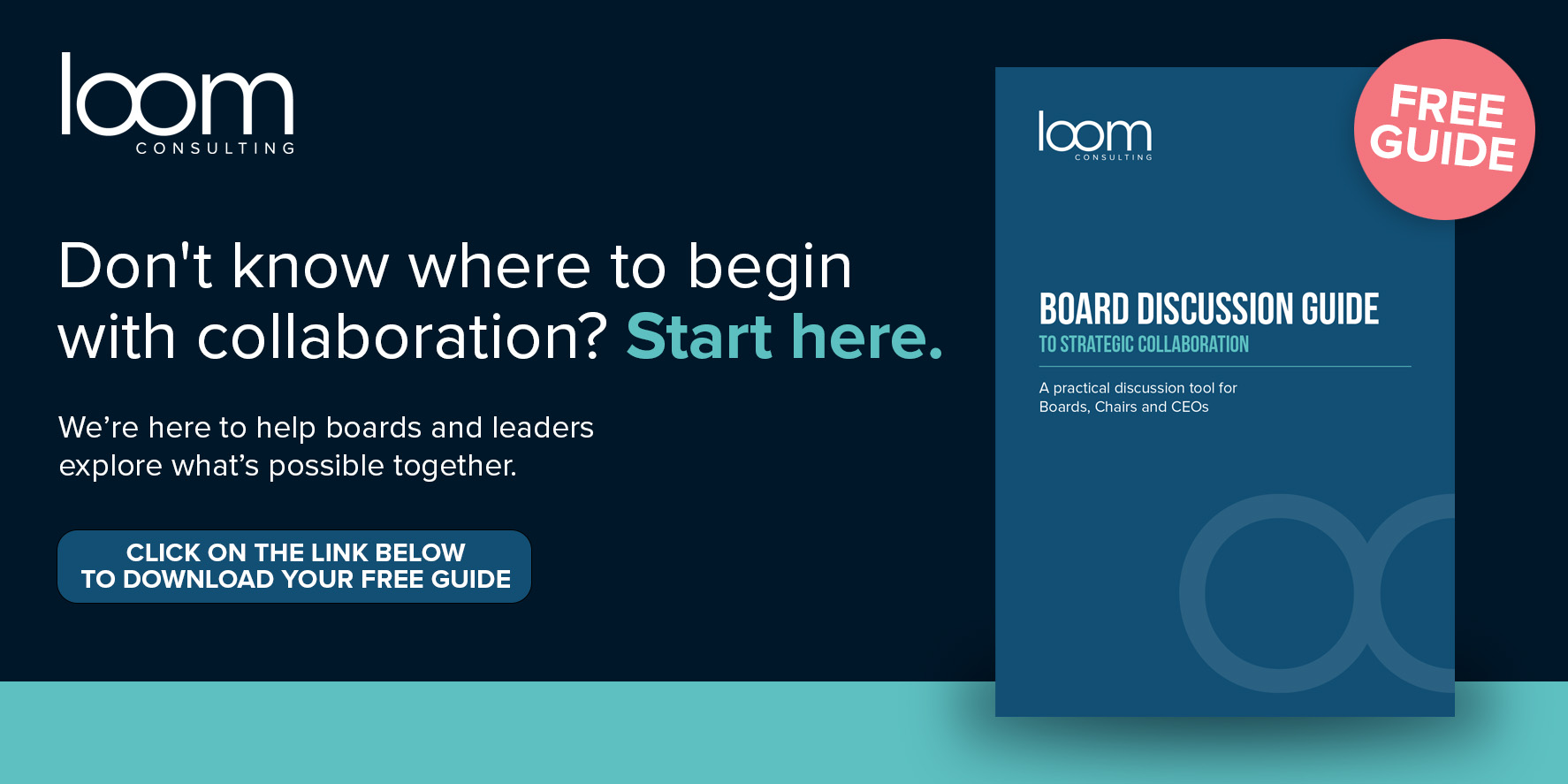
That is why I have developed Loom's Board Discussion Guide to Strategic Collaboration. It gives boards, chairs and CEOs a practical starting point for a conversation that can otherwise feel too broad, too sensitive or too difficult to place on the agenda.
Start With the Mission
A collaboration discussion can quickly become a conversation about another organisation.
Someone suggests a potential partner. Directors begin considering compatibility, reputation, leadership and history. Questions about control and identity follow.
These are good questions, but only at the right time. First a board needs to understand what it is trying to achieve via collaboration.
What will our community need from us in five to ten years? What capabilities will that require? How confident are we that we can develop and sustain those capabilities ourselves?
Starting here gives collaboration a clear purpose. It helps directors assess whether working differently could strengthen mission delivery, rather than searching for an activity to fulfil a line in the strategic plan.
It also makes room for an honest conclusion that the current model remains appropriate. That is always a possibility — but that should be an honest and intentional commitment.
Give Directors a Manageable First Step
One reason collaboration can remain unexplored is that opening the conversation feels like setting something much larger in motion.
A director may worry that raising the subject will be interpreted as a loss of confidence in the organisation. A CEO may anticipate concerns about independence or leadership roles. Others may assume the discussion will lead directly to merger.
The guide establishes a more manageable task.
The board is considering whether strategic collaboration deserves further exploration. That is a useful decision in its own right, with no need to select a partner or preferred structure at the first meeting.
The possibilities can include shared services, joint programs, alliances and, where there is a strong case, deeper integration. Each needs to be assessed against the organisation's purpose, capabilities and circumstances.
Five Questions to Open the Discussion
The guide centres on five questions directors can consider before the meeting:
- 1. Purpose and impact If we were designing the best way to deliver our mission today, would it look like our current organisation?
- 2. Sustainability How confident are we in our financial, operational, strategic and organisational sustainability?
- 3. Urgency When could our most significant challenges materially affect mission delivery?
- 4. Capability What might we need over the next five to ten years that we may struggle to build alone?
- 5. Strategic options What role, if any, should collaboration play in our future?
These questions help a board look beyond immediate financial performance. An organisation can be solvent while facing growing pressure on its workforce, systems, governance capacity or executive depth.
They also bring differences in perspective into view. If some directors see an immediate challenge while others believe it is several years away, the board has something important to discuss before it can agree on a response.
Turn the Conversation Into a Clear Next Step
A useful discussion should leave the board clearer about what happens next.
That might mean revisiting the question in a year, gathering better evidence about a capability gap, undertaking a readiness assessment or commissioning a scan of potential collaboration opportunities.
It may also mean deciding that no further action is warranted at present.
The guide includes facilitation notes for chairs and CEOs, prompts to deepen the discussion and possible next steps. Its purpose is to help boards reach a considered position and give that position a practical consequence.
Exploring early creates time to understand the options, build relationships and test assumptions. Those activities become harder when an organisation is already under significant pressure.
For boards that have yet to discuss collaboration, the guide offers a place to begin. For those with collaboration already in their strategy, it provides a way to give that commitment substance.
Download Loom's Board Discussion Guide to Strategic Collaboration and use it to start the conversation at your next board meeting.