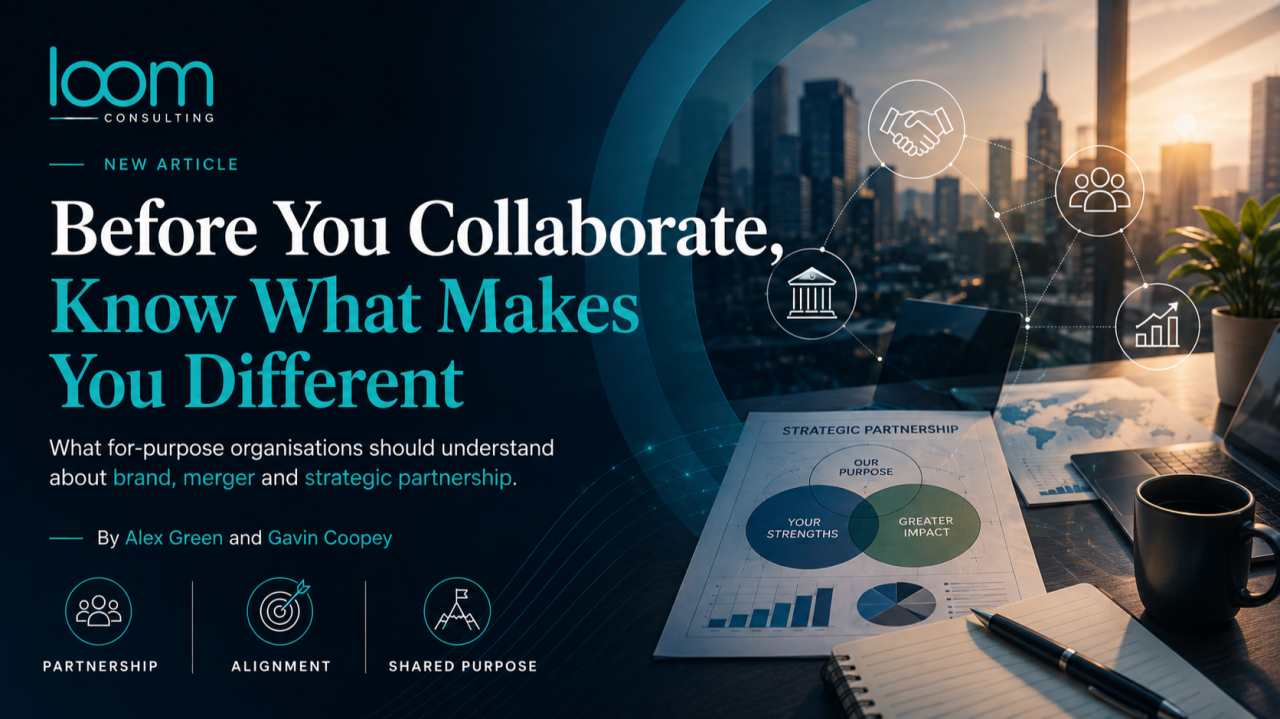
What for-purpose organisations should understand about brand, merger and strategic partnership.
Key Takeaways
- Brand strength is not only about awareness. It is about whether people understand what your organisation does better, differently or more credibly than others.
- Collaboration and merger conversations become clearer when each organisation is honest about its strengths, weaknesses and role in the market.
- Mission-led mergers have a stronger foundation because the case for change is anchored in impact, rather than structure alone.
- Collaboration can be a practical route to innovation when an organisation works with others who are stronger in areas it should not try to build alone.
- The best time to explore partnership, collaboration or merger is from a position of strength, while there is still choice.
Many for-purpose organisations spend a lot of time trying to become better known.
That is understandable. Awareness matters. Donors, funders, partners and communities need to know an organisation exists before they can support it, trust it or work with it.
But awareness is only part of the work.
A better question is whether people understand what the organisation is known for.
In my recent conversation with Gavin Coopey, one point came through very clearly. Brand strength is not simply about being recognised. It is about differentiation. What is the essence of the organisation? What is the point of difference? What can people say with confidence that this organisation does better, or more credibly, than anyone else?
That question matters all the time, but it becomes especially important when organisations begin exploring collaboration, partnership or merger.
"If an organisation is not clear about what makes it different, it will struggle to know what it should protect, what it should share, what it should stop doing, and where another organisation may be better placed to lead."
Awareness Is Not the Same as Value
For-purpose leaders can become understandably focused on awareness. It is visible, measurable and often easier to talk about than differentiation. A board can ask whether more people know the organisation. A fundraising team can track campaign reach. A marketing team can measure recognition.
Those measures have their place. The harder question is whether awareness is connected to something meaningful.
Gavin used Manchester United FC (he's a fan!) as a simple example. A brand can be widely known and still lose its way if it becomes unclear about what makes it distinctive. For a football club, that may be a style of play, a development pathway, a history, or a particular identity that supporters understand and believe in.
For a charity or for-purpose organisation, the principle is similar. What is the organisation’s real point of difference? What does it do with particular credibility? What is the thing funders, partners, beneficiaries or supporters should immediately associate with it?
This becomes even more important in a crowded sector where many organisations appear to be working on similar issues. Mental health is an obvious example. Saying an organisation works in mental health may be true, but it is often too broad to be useful. There are many different needs, populations, service models and areas of expertise sitting under that phrase.
Without greater clarity, the brand becomes hard to distinguish. It becomes more difficult for partners to understand where the organisation fits. It becomes harder for boards to make decisions about what to pursue and what to leave to others.
That is where brand becomes a strategic discipline, not just a communications exercise.
Collaboration Needs Honesty About Strength
One of the useful lessons from Gavin’s experience with major charity mergers is the importance of honesty.
In a merger, each organisation brings different strengths and relative weaknesses. One may have stronger fundraising capability. Another may bring communications strength. One may have deeper program expertise. Another may bring scale, systems or reach.
The difficulty is that merger and collaboration conversations often become polite before they become honest. People may avoid naming power dynamics. They may soften the differences between organisations. They may describe a transaction as equal when the practical balance of capability tells a more complicated story.
That can make the conversation feel safer at the beginning, but it creates problems later. A stronger process allows leaders to be clearer about what each organisation genuinely brings. That does not mean reducing one organisation to its weaknesses or allowing the stronger party to dominate the discussion. It means making the real value of each organisation visible enough for the future model to be designed well.
The best partnerships often begin with a mature version of this question:
“What do we do well, and what might someone else do better?”
That question can be uncomfortable. It asks leaders to separate mission from organisational pride. It asks boards to look beyond history and brand attachment. It also opens the door to better decisions.
Sometimes the answer may be partnership. Sometimes it may be shared services, a joint program, a strategic alliance or merger. Sometimes it may simply be a clearer decision to stop trying to do everything internally.
Mission-Led Merger Has a Stronger Base
Gavin’s reflections on the Cancer Research UK merger are useful because the case was not only about scale or financial growth. Those benefits mattered, but the deeper rationale sat closer to mission.
Two organisations with different histories and areas of strength came together because the distinction between their work had become less useful than the opportunity to bring it together. The logic of the merger was based on shared purpose: to help people with cancer.
A merger that is led only by pressure can quickly become defensive. A merger led only by efficiency can struggle to carry people emotionally. A merger led only by structure can become consumed by governance, branding, roles and internal power.
A mission-led merger gives people a different place to stand.
It gives boards and executives a reason to work through the difficulty. It gives staff a clearer explanation for why change is being considered. It gives supporters and stakeholders a way to understand the future benefit, not just the internal adjustment.
This does not make the process simple. Cultural integration still takes time. People bring loyalties, habits and internal knowledge from the organisations they came from. Language often reveals whether the new entity has truly become real. But when the reason for merger is grounded in mission, the process has a stronger centre of gravity.
Brand Can Be an Asset or a Risk
Brand questions can become very charged in merger and collaboration work.
A name may carry history, trust and recognition. It may also carry limitations. Some organisations need to change their name because the existing brand has become a barrier to the work. Others may be tempted to rebrand because a merger feels like it needs something new.
Gavin made a practical point here. Charities often have less brand equity than they think, and where strong equity exists, leaders should be very careful before giving it away.
A new name can feel clean and neutral. It can also have no meaning, no memory and no trust behind it.
That is why brand should not be treated as a cosmetic decision in merger work. It is part of the strategic asset base of the organisation. It affects supporters, staff, partners, funders and the communities the organisation exists to serve.
The right question is not simply, “What should the new name be?” A better question is: “What brand equity do we already hold, and how does that help or hinder the mission we are trying to advance?”
That question deserves evidence, not just opinion.
Collaboration Can Be a Route to Innovation
Innovation is often treated as if it needs to be large, disruptive and separate from the daily work of the organisation.
Gavin offered a simpler view: innovation can begin with doing tomorrow’s work better than today’s. It can be incremental. It can live in the way teams ask better questions about effectiveness, efficiency and impact.
Collaboration can accelerate that. An organisation may not need to build every capability itself. It may be able to work with another organisation that already has the expertise, systems or credibility in a particular area. That is not a failure of ambition — it can be a more disciplined way to protect focus.
This is particularly relevant in large, complex service systems where mission creep is common. Organisations may keep expanding because the need is visible and the funding opportunity is present. Over time, the organisation can find itself doing work that is adjacent to its mission but not central to its strength.
Collaboration gives leaders another option. It allows an organisation to help something happen without needing to own every part of it. That can be a more mature form of leadership.
Explore Before You Need To
The timing of these conversations matters. Gavin’s advice to boards and executives was clear: the best time to consider collaboration, consolidation or merger is before the organisation needs to.
By the time an organisation is up against the wall, the room has changed. Options are fewer. Time is shorter. Potential partners may have less confidence. What could have been a strategic conversation can become a last resort.
That is a difficult position for any board. It is also why stronger organisations should not confuse current stability with future readiness.
If the environment is changing, if demand is shifting, if funding is becoming harder, if capability gaps are growing, or if the organisation’s role in the market is becoming less clear, the board has a responsibility to look ahead.
The question is not whether the organisation is failing. The question is whether its current model gives the mission the best chance of future impact.
That is where brand, collaboration, merger and innovation meet.
A clear point of difference helps an organisation understand where it should lead. Honest collaboration helps it understand where others may be stronger. Mission-led merger creates a stronger case for structural change. Innovation keeps the organisation asking how the work can be done better.
For-purpose organisations do not need to become everything to everyone.
Before you collaborate, know what makes you different.
References & Watch
- Video:{" "} Watch the full discussion with Gavin Coopey on YouTube
- LinkedIn:{" "} Read and discuss on LinkedIn
- Services:{" "} Explore Loom Consulting’s Merger & Strategic Partnership services